Friedrich Nietzsche(1844-1900): the German Philosopher declared “God is Dead.”

Sōsuke Aizen: The main antagonist of Tite Kubo’s popular manga/anime series Bleach. The man who surpassed both Soul Reapers and Hollows.

Education: the process of giving and receiving systematic knowledge through a formal setting

What, you may be wondering, do these three things have in common with each other? I don’t know but that is for the students to find out.
Overview regarding this topic
The definition that I have above of education is a slightly modified version of the dictionary definition of education. I believe it is a highly insufficient model of education. Education is not just transmitting knowledge. In fact, that definition is probably the farthest thing from education. Rather, education is the constructing of the moral, intellectual and critical minds of the next generations of humans. Too often, we think of education through the mindset of grades, papers, tests and statistics. We forget the fact that teachers are forming an entire generation of human beings, who will in turn forge a new generation after them. As such, this limited mindset of tests and papers must be supplemented with critical thinking skills that will help students to determine right from wrong in the world.
Specifically in English Language Arts, the moral side is often either over moralized, as Juzwik mentions in her article, or generally ignored. Often, teachers are too occupied asking what is the conflict in the story and forget the ask the students: “what do you think of this conflict? Who is right and who is wrong?”
This general over moralization of texts runs the risk of actually decreasing the critical thinking skills of students. They are not forced to answer the big questions about the text.
Just to be clear, I am not simply talking about reader-response. What I am talking about is a deeper reading and application of the events, characters and ideas presented to the texts into our real world literacy. How can what students read in the text influence how they read the world.
Now, let us look at a hypothetical example of this kind of deep-thinking literary study.
An brief overview of Nietzsche
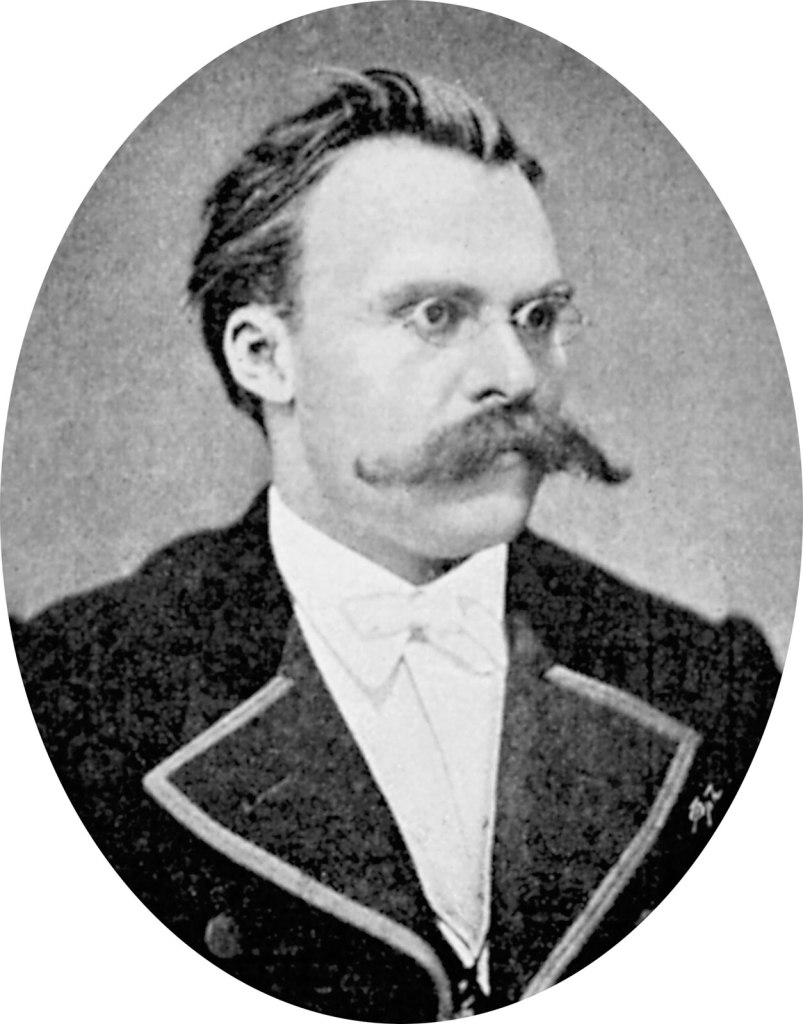
This is not a philosophy blog so I will keep the discussion on Nietzsche as focused as possible. Friedrich Nietzsche revolutionized modern philosophy. He is most well know for his ideals of the Übermensch, existentialism, anti-nihlism/nihilism, and the “death of God.” For the sake of this discussion, we will be focusing on the former and the latter.
His famous “God is dead” quote steamed from his belief that the development of European society had effectively “killed” the Jeudo-Christian God. With that death, Nietzsche believed that Christian morality, which he despised, and all forms of morality and reality had perished. However, Nietzsche believed heavily in the power and ability of mankind. He constructed the Übermensch, which roughly translates as the “super-man” or “overman” to fill that role.
The Übermensch was a philisophical goal which Nietzsche set for humanity. This “overman” would create a brand new world order and a new worldly morality that would replace the now “dead” Jeudo-Christian God.
Aizen: Tite Kubo’s Übermensch

Again, this is not an anime/manga blog so I will keep everything on Aizen to the basics.
Sōsuke Aizen, originally introduced in chapter 79 of Tite Kubo’s hit manga series Bleach, seemingly an answer to Nietzsche’s desires. Sōsuke Aizen is a member of the Shinigami(lit. Death Gods) or Soul Reapers and works under the Soul Society. However, as the series progresses, it is revealed that Aizen is actually a Machiavellian super villain who becomes the main antagonist of the series.
However, it is Aizen’s personal motivations and philosophy that make him note worthy. Aizen despises the Soul King, the Bleach series’ version of God, and wishes to eradicate the established, and in his view, corrupt social order.
Importantly, Aizen is presented as seemingly perfect. He is stronger and smarter(and better looking) than every other character in the entire series.
Thus, we see a very clear connection to Nietzsche’s Übermensch. Aizen, the “superior being” will kill “God” and establish a superior order.
Using student’s interests to further educaiton.
Bringing this back to education, we will set up a hypothetical situation. Let’s say that Bleach is super popular with students right now. Thus, we, the teacher, have decided to teach capitalize on it for educational purposes.
Here, we are presented with an incredible opportunity. Kubo has clearly drawn on Nietzsche to create Aizen, then we will use that to teach our students as well.
Rather than just having students answer questions about: what is Aizen’s motivation and how does this impact the conflict, we will instead ask students to apply this to the real world.
We will have students compare Nietzsche’s philosophies to Aizen’s character.
“Would Nietzsche approve of this kind of person? Is Aizen right or wrong? Is Nietzsche right or wrong? Is the society I live in corrupt? If so, is Aizen’s path the right way? Is Nietzsche right about morality? And what bad things can happen if people do follow Nietzsche?”
An important point about Nietzsche is that many of his philosophies were adopted by Nazism. So students should also be informed of this.
From here, with Aizen as a base, students should ask:
“Would Nietzsche approve of Nazism? Is the Nietzschen philosophy dangerous? Do these philosophies encourage dangerous political parties? And is this philosophies inherently biased against religions and minorities? And should I adopt a life philosophy like this?”
Juzwik points out that students that are left unattended can be misled into dangerous mindsets. As such the teacher should be present guiding these discussions. However, these are the kinds of discussions that should be engaging students.
Students, with a familiar subject matter, are encouraged and challenged to think deeper about how they process the world.
Concluding Thoughts
Obviously this example is unrealistic. However, I think it provides a good model. Students should be challenged in their thinking and literacy has the means to do that.
Kids are not stupid and teachers should not dumb-down their learning. Literature, of any kind, opens a student’s mind to the various life-philosophies that they can encounter in the world. If left unguided, they may be lost and confused.
It is the responsibility of teachers to teach students to interact responsibly and critically with the world, and literary studies are the gate-way to that deeper learning.
Works Cited:
Juzwik, M. M. (2013). The ethics of teaching disturbing pasts: Reader response, historical contextualization, and rhetorical (con) textualization of Holocaust texts in English. English Education, 45(3), 284-308
Tite Kubo’s Aizen and the Depth’s of Themes. From Reddit, by user SkiScotch
 From the Round Table